
Additive manufacturing for electronic cabinets
3D printing as a production tool — not just prototyping — for electronic cabinets in low and medium scale.
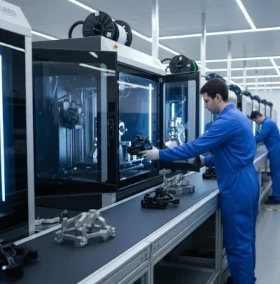
When 3D printing makes sense for cabinets
Cabinets produced in 3D printing are a good option when at least one of the conditions below is true:
- Low or medium volumes: dozens to a few thousand units — volumes too small to justify an injection mold.
- Pilot / pre-series phase: validating mechanics, thermal and ergonomics in real use, refining the project before "freezing" the geometry.
- Niche product by nature: specialized equipment, custom variants per client or per site, limited total volume.
- Short deadlines and project agility: intends to adjust the cabinet between batches, without being stuck on a single mold configuration.
In these conditions, a well-designed cabinet for 3D printing can be the correct engineering compromise between cost, flexibility and performance.
Volume ranges and typical scenarios
50–200 units
Initial series for field tests, pilots or internal use. High probability of design adjustments after feedback.
200–1.000 units
Pre-series or niche products, usually B2B or industrial. Reasonable unit cost, but mold investment is still difficult to justify.
1.000+ units
Stable demand but niche. Total volume small compared to mass consumer products.
Technical aspects of printed cabinets
Using 3D printing as a production method requires engineering decisions in several areas:
Mechanical behavior
- Wall thicknesses and ribs adapted to FDM process
- Control of layer orientation in critical regions
- Reinforcement strategies for screw columns, clips and fixation points
Thermal and environmental aspects
- Material choice consistent with operating temperature range
- Ventilation and air flow paths when necessary
- Impact of installation environment (inside panel, wall, shelter)
Tolerances and assembly
- Realistic tolerances considering process and post-process
- Design of joints, interfaces and clearances for repeatable assembly
- Compatibility with catalog components (connectors, cable glands, displays)
When not to use 3D printing
As important as knowing where 3D printing fits is knowing where it should not be used.
Printed cabinets are not recommended when:
- The volume and product stability clearly justify injection molding — tens of thousands of units, consolidated project.
- There are regulatory or mechanical requirements that demand materials or tolerances incompatible with FDM for that specific case.
- The target market demands cosmetic finish identical to large-scale consumer electronics.
In these situations, the correct path is to use 3D printing only in initial validation phases and plan mold and injection as soon as the project is mature.
This discussion is part of the service: the goal is to support a technically sound decision, not "force" 3D printing where it should not be applied.
Integration with product development
The additive manufacturing work is rarely isolated. Normally, it is part of a larger product development effort:
- From prototype to pilot series: transforming "lab cabinets" into consistent enclosures
- Bridge to injection: designing already considering future mold restrictions
- Variants and customization: organizing families of models, maintaining consistent mechanical interfaces
The goal is to take cabinet decisions that converse with the product roadmap, not just with the next batch.
What is not offered
To maintain focus on engineering and B2B scenarios, this service line does not include:
- Individual printing of decorative objects, miniatures, keychains, giveaways
- Generic printing services without associated engineering work
- Generic services of "we print any STL you send"
The focus is on electronic cabinets and related mechanical parts, within real projects.
Cost Simulator: AM vs Injection
Want to understand at which volume each process makes sense? Use our conceptual simulator to compare costs between additive manufacturing and injection molding.
- Enter weight, dimensions and part complexity
- Visualize total cost curves vs quantity
- Identify the approximate break-even point
Support materials
For a deeper discussion, the Downloads page includes a study on additive manufacturing for electronic cabinets in low and medium scale.
This material brings numbers, scenarios and a more detailed analysis of cost and deadline trade-offs.
See downloadsConsidering 3D printed cabinets?
Describe briefly the product, volumes and restrictions. From there, a specific analysis can be made.